Open Daily, 10 a.m. - 5 p.m.


Field Trip Programs
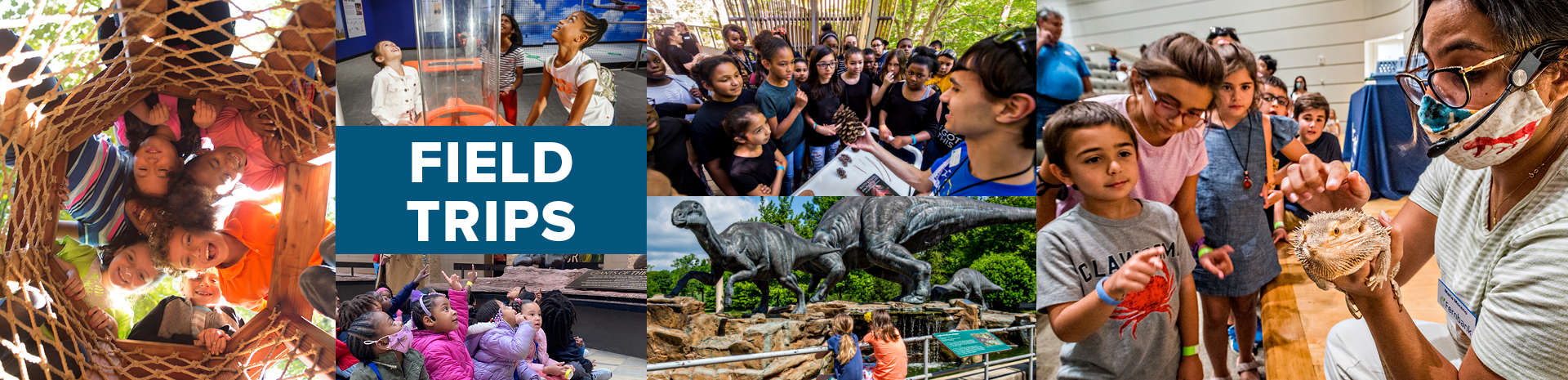
Enhance your students’ Fernbank experience with a school program. Fernbank educators use active discussion, fun visuals, live specimens and unique artifacts to engage students.
All programs are correlated with Georgia Standards of Excellence.
Programs are only available from August – May.
Call or register online for your requested date, time and program.
Auditorium Programs
Offered Mon. – Fri. at 10:15 a.m., 11:15 a.m. and 12:15 p.m.
Designed for larger school groups, science comes alive with discussion, demonstrations and exciting visuals in our auditorium-style programs! Discover the amazing, dynamic processes of Earth and Life Sciences.
Minimum: 50 Students | Maximum: 170 Students | Duration: 45 minutes
Explore the world of plants and animals in a fun and hands-on way. Through performances, audience participation, and live animal encounters, your students will learn about the basic needs of plants and animals and their life cycles.
Curriculum Correlations:
- Identify the characteristics and basic needs of plants and animals. S1L1b
- Explore parts of a plant and compare and describe various animals. S1L1a
- Investigate the life cycles of different living organisms. SKL2c; S2L1a,b,c,d
What can fossils teach us about Earth’s past? How do they further our understanding of the landforms we know today? Through the use of visuals, models, and fossils, students will learn the answers to these and other paleontological questions in this minds-on field trip.
Curriculum Correlations:
- Compare fossils to each other and the original organism. S3E2a
- Understand how fossils are clues to an extinct organism’s appearance and behavior. S3E2a
- Understand what fossils can teach us about an environment’s past. S3E2a
- Discuss how fossils are formed. S3E2b
Discover the wonders of the animal kingdom as you meet members of Fernbank’s live animal collection. Invertebrates, reptiles, and amphibians will help your students understand habitats, adaptations, and the important roles these animals play in the environment. Our animal ambassadors will inspire your students to appreciate and protect the natural world.
Curriculum Correlations:
- Discuss how animals are identified and compare different animal groups. S5L1a
- Explore how external features and adaptations of animals allow them to survive in their habitat. S3L1b
- Identify the roles of organisms and the flow of energy within an ecosystem. S4L1
- Discuss the taxonomic classification of major animal groups and compare their physical characteristics. S7L1
- Discuss the roles of animals in the food chain as consumers and as prey to other animals. S7L4a,b
- Study the behavior and life history of animals, focusing on their survival adaptations. S7L4a
- Discover the importance of animals in the environment. S7L4
Witness the awesome power of planet Earth and learn what goes on beneath the surface to create these awe-inspiring events. Using demonstration and discussion, students will explore what drives these geologic events and learn more about the role of plate tectonics in shaping our planet.
Curriculum Correlations:
- Discover the destructive and constructive properties of earthquakes and volcanoes. S5E1a
- Explore the inner workings of the earth as well as these events. S5E1b
- Learn how humans are working to predict these geologic events and how to minimize their impact. S5E1c
Discover the history and diversity of our state’s regions and their unique natural resources. Through discussion, demonstration and a live animal presentation, students are entertained and enlightened as they learn about our remarkable state and its ecosystems.
Curriculum Correlations:
- Learn the geography and basic features of Georgia’s natural regions. S3L1
- Examine basic geologic principles that shaped the state. S3E1c; S5E1a
- Look at some common plants and animals found in the regions and their relationship to the landscape. S3L1b,c
Weather is around us all the time, but how much do we really understand the processes behind the wind and rain and sun of daily life? Explore the wild world of weather through interactive demonstrations and discussion. Students will discover why weather changes, how clouds form, and the innerworkings of extreme weather events—all without getting wet.
Curriculum Correlations:
- Identify the difference between weather and climate. S4E4d
- Recognize the role of the sun and uneven heating in weather systems. S3P1b; S4E2
- Discover the water cycle, resulting cloud types, and different forms of precipitation. S4E3; S4E4c
- Recognize weather instruments and maps how to identify fronts and their associated weather. S4E4a,b
- Explore large weather systems: thunderstorms and lightning, hurricanes, and tornadoes. S5P2a
Investigations
Offered Tues., Wed. and Thurs. at 10:15 a.m., 11:15 a.m. and 12:15 p.m.
Sharpen your science skills in our inquiry-based investigations. Observe and explore the worlds of earth and life sciences through hands-on activities and experiments.
Note: All of our investigation programs are designed for outdoor exploration; please review program descriptions for details.
Minimum: 15 Students | Maximum: 30 Students | Duration: 45 minutes
How do organisms survive and relate to one another in Georgia Piedmont forests? Students will explore habitats and participate in inquiry-based activities in this outdoor program to discover the unique and important roles different plants and animals play in Piedmont forests. Students will study adaptations, survey for animal signs and construct a “web of life” model of a forest ecosystem.
Curriculum Correlations:
- Explore how adaptations, both external features and behaviors, help animals survive in their habitat. S3L1b
- Model the flow of energy from producers to consumers in an ecosystem. S4L1b
- Discover the role of biodiversity in maintaining the flow of energy and stability in an ecosystem. S3L2b; S4L1d
What factors indicate ecosystem health? Students will evaluate the health of Fernbank Forest through conducting water testing, collecting data along the way. Students will discuss how invasive species and different organisms can impact their ecosystems.
Curriculum Correlations:
- SB5a – Plan and carry out investigations and analyze data to support explanations about factors affecting biodiversity and populations in ecosystems.
- SEV2d – Construct an argument to support a claim about the value of biodiversity in ecosystem resilience including keystone, invasive, native, endemic, indicator, and endangered species.
Guided Hikes
Offered by request, Mon. – Fri. at 10:15 a.m. and 11:45 a.m.
Gain a better understanding of the interconnected Piedmont forest ecosystem and the importance of biodiversity during this interpretive tour of Fernbank’s outdoor campus. Participants will explore the ecology, habitats, characteristics of an old-growth forest and more while developing a deeper appreciation for the natural world.
Comfortable walking shoes and water bottles are recommended for these programs.
Minimum: 15 Students | Maximum: 40 Students | Duration: 45 - 90 minutes
During this 45-minute tour, participants will see first-hand the ecology and characteristics of Fernbank Wild Woods while developing an appreciation for the natural world. Students will gain a better understanding of the Piedmont Forest ecosystem and the importance of native habitats during a guided interpretive tour of Fernbank WildWoods. WildWoods Walks are ADA accessible.
Curriculum Correlations:
- Obtain, evaluate, and communicate information about the basic needs of plants and animals. S1L1
- Identify the causes of change in the environment. S2E3
- Compare and contrast habitats and the adaptations of animals who live there. S4L1;S5L1
During this 90-minute tour, students will gain a better understanding of the interconnected Piedmont Forest ecosystem. Examine the importance of native biodiversity in Atlanta’s only remaining old-growth forest, Fernbank Forest. Due to rough terrain in Fernbank Forest, forest tours are not ADA accessible.
Curriculum Correlations:
- Understand the role of water and human activity on Earth’s surface. S6E3, S6E5, SES3, SES4, SES6
- Examine the dependence of organisms on each other and their environments, including human impacts. S7L4, SB5, SEV4
- Describe the flow of energy and changes in Earth’s ecosystems. SEV1, SEV2
Make a reservation online or contact the Field Trip Team at 404.929.6320 or Field.Trips@FernbankMuseum.org.

Fernbank is a nonprofit natural history museum, giant screen theater and old-growth forest, and is not affiliated with Fernbank Science Center, which operates as a division of DeKalb County Schools.